Shoulders to Scalp Recovery. Myofacial relief and glide cupping for upper body

Why Your Jaw, Neck & Shoulders Are All Connected and What to Do About It
By Siobhan Kelly, LMT & Certified Lymphatic Therapist | Noma Bodywork, Sonoma, CA
If you have ever noticed that your jaw feels tight when you are stressed, or that your headaches seem to start at the base of your skull and radiate to your all the way to your eyes, you are not imagining a connection. The jaw, neck, and shoulders function as one integrated system, and when one area is under chronic tension, the others follow.
This is the foundation of the work I do in my new session: Head, Neck & Shoulder Reset with Myofascial Release and Lymphatic Glide Cupping.
Jaw Pain Is a Muscle Problem, Not Just a Joint Problem –
side note: “TMJ” refers to the Temporomandibular joint (jaw), “TMD” refers to Temporomandibular joint disorder
Most people think of TMD as a joint issue, something structural, something that requires a dentist or a specialist with a mouth guard. And sometimes it is. But the majority of TMD presentations are myogenic, meaning they originate in the muscles, not the joint itself.
The muscles of mastication, the masseter, temporalis, medial and lateral pterygoids, are responsible for chewing, clenching, and bracing. Under chronic stress, these muscles hold tension around the clock, often without the person being aware of it. That tension creates pressure, restricted movement, and referred pain that can travel into the temples, behind the eyes, and down the neck.
Manual therapy targeting these muscles has demonstrated meaningful improvements in pain intensity and jaw function across multiple randomized controlled trials (Vieira et al., 2023).
Forward-Head Posture and the Neck-Jaw Link
Here is something most people do not know: the position of your head directly affects your jaw. When the head shifts forward, as it does with prolonged desk work, phone use, or driving, the suboccipital muscles at the base of the skull shorten and tighten. This pulls on the structures above and below, altering jaw mechanics and increasing the load on the muscles of mastication.
This is why treating the jaw in isolation rarely resolves the full picture. The trapezius, sternocleidomastoid (SCM), scalenes, and suboccipital muscles all need to be addressed as part of the same pattern.
Myofascial release has been shown to produce significant improvements in both the trapezius and suboccipital muscles in people with chronic neck pain (Guo et al., 2023), and a 2024 meta-analysis of ten randomized controlled trials found significant pain reduction with myofascial release for chronic neck pain overall (Overmann et al., 2024).
Shoulders to Scalp Recovery: A Combination Approach
This session works in two distinct parts.
Part 1) Myofascial Release: I begin with direct manual work on the shoulders, neck, face, jaw, and scalp. The goal is straightforward; reduce muscular tension, release restricted fascia, and prepare the tissues for the second phase of treatment.
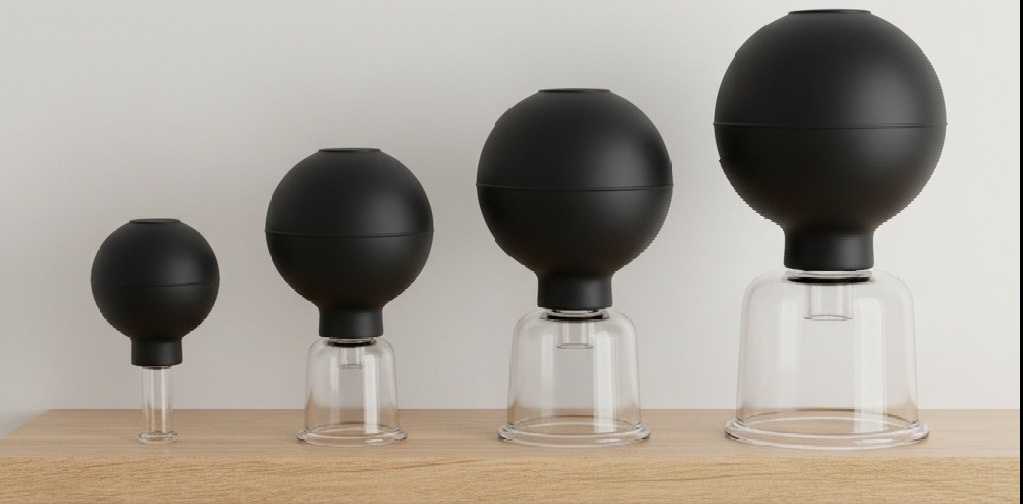
Part 2) Lymphatic Glide Cupping: I use moving glass cups to create negative pressure on the skin and underlying tissue; think of it as a gentle vacuum. This draws the muscles and fascia upward rather than compressing them downward. The result is simultaneous treatment of both the muscular and lymphatic systems. Most clients report this as their favorite part of the session; it is a sensation that simply does not exist in traditional massage.
*Because the cups are constantly moving, this technique will not leave the red or purple circles associated with stationary cupping.
The Emotional Component
Jaw clenching is not purely mechanical. For many people, it is where stress lives in the body. The jaw is one of the first places we brace when we are overwhelmed, anxious, or holding something back. Chronic emotional stress creates chronic muscular tension, and that tension does not release on its own just because the stressor is gone.
This is why nervous system down-regulation is built into this session. The work is slow, intentional, and supine. The goal is not just to release the tissue, it is to give your nervous system permission to stop bracing. Put more simply, you will feel extremely relaxed.
Bonus
For those with deep jaw tension I offer intra-oral “buccal” massage at the beginning of the treatment. I focus on the pterygoid muscles inside the mouth. These muscles can only be reached through intra-oral work.
Results Over Hype
“Buccal massage” and “facial sculpting” are currently trending on social media as “natural Botox.” I do not use these marketing terms. Facial work increases blood flow and can temporarily soften fine lines; however, my focus is strictly functional.
Is This Right For You?
This is a “hair-up” session. I work the entire scalp and neck; please arrive expecting your hair and makeup to be displaced.
This session is indicated for:
- Chronic Jaw pain (TMJ/TMD)
- Migraines or tension headaches
- Neck and Shoulder muscular pain ex. “Tech Neck”
- High-stress individuals needing deep relaxation
- Tinnitus symptoms can show improvement with this treatment
- People who prefer to stay face up (supine) during a massage
Contraindications
Please reschedule if you have had Botox injections in the past week, or if you are experiencing acute, severe jaw pain. In that case, a dentist, PT, or chiropractor should be contacted first.
To book a treatment click here: My Services
For more information about the lymphatic system and Myofacial Release, take a look at my previous posts:
Myofascial Release: What It Is, Who It Helps, and What to Expect
Lymphatic Massage vs. Manual Lymphatic Drainage (MLD): What’s the Difference?
Links to research:
- Vieira et al., 2023 – Manual therapy for TMD: https://www.mdpi.com/2075-1729/13/2/292
- Guo et al., 2023 – Myofascial release for chronic neck pain: https://pubmed.ncbi.nlm.nih.gov/36305079/
- Overmann et al., 2024 – Myofascial release meta-analysis: https://pubmed.ncbi.nlm.nih.gov/38290198/